Thursday, 7 March 2019

Glycolysis - Detailed

Glycolysis
•      The Glycolytic pathway describes the oxidation of glucose to pyruvate with the generation of ATP and NADH 

•      It is also called as the Embden-Meyerhof Pathway 

•      Glycolysis is a universal pathway; present in all organisms: from yeast to mammals. 

•      In eukaryotes, glycolysis takes place in the cytosol 

•      Glycolysis is anaerobic; it does not require oxygen 

•      In the presence of O2, pyruvate is further oxidized to CO2. In the absence of O2, pyruvate can be fermented to lactate or ethanol. 

•      Net Reaction: Glucose + 2NAD+ + 2 Pi + 2 ADP = 2 pyruvate + 2 ATP + 2 NADH + 2 H2O 

 
The 3 stages of Glycolysis 
•      Stage 1 is the investment stage. 2 mols of ATP are consumed for each mol of glucose 

•      Glucose is converted to fructose-1,6-bisphosphate. 

•      Glucose is trapped inside the cell and at the same time converted to an unstable form that can be readily cleaved into 3-carbon units. 

•      In stage 2 fructose-1,6-bisphosphate is cleaved into 2 3- carbon units of glycerladehyde-3-phosphate. 

•      Stage 3 is the harvesting stage. 4 mols of ATP and 2 mols of NADH are gained from each initial mol of glucose. This ATP is a result of substrate-level phosphorylation

•      Glyceraldehyde-3-phosphate is oxidized to pyruvate 


Step-wise reactions of glycolysis 
•      Reaction 1: Phosphorylation of glucose to glucose-6 phosphate. 

•      This reaction requires energy and so it is coupled to the 
hydrolysis of ATP to ADP and Pi. 

•      Enzyme: hexokinase. It has a low Km for glucose; thus, once glucose enters the cell, it gets phosphorylated. 

•      This step is irreversible. So the glucose gets trapped inside the cell. (Glucose transporters transport only free glucose, not phosphorylated glucose) 

•      Reaction 2: Isomerization of glucose-6-phosphate to fructose 6- phosphate. The aldose sugar is converted into the keto isoform. 

•      Enzyme: phosphoglucomutase. 

•      This is a reversible reaction. The fructose-6-phosphate is quickly consumed and the forward reaction is favored. 

   
Step-wise reactions of glycolysis (continued) 
•      Reaction 3: is another kinase reaction. Phosphorylation of the hydroxyl group on C1 forming fructose-1,6- bisphosphate. 

•      Enzyme: phosphofructokinase. This allosteric enzyme regulates the pace of glycolysis. 

•      Reaction is coupled to the hydrolysis of an ATP to ADP and Pi. 

•      This is the second irreversible reaction of the glycolytic pathway. 

•      Reaction 4: fructose-1,6-bisphosphate is split into 2 3-carbon molecules, one aldehyde and one ketone: dihyroxyacetone phosphate (DHAP) and glyceraldehyde 3-phosphate (GAP). 

•      The enzyme is aldolase. 

•      Reaction 5: DHAP and GAP are isomers of each other and can readily inter-convert by the action of the enzyme triose-phosphate isomerase. 

•      GAP is a substrate for the next step in glycolysis so all of the DHAP is eventually depleted. So, 2 molecules of GAP are formed from each molecule of glucose 

    
Step-wise reactions of glycolysis (continued) 
•      Upto this step, 2 molecules of ATP were required for each molecule of glucose being oxidized 

•      The remaining steps release enough energy to shift the balance sheet to the positive side. This part of the glycolytic pathway is called as the payoff or harvest stage. 

•      Since there are 2 GAP molecules generated from each glucose, each of the remaining reactions occur twice for each glucose molecule being oxidized. 

•      Reaction 6: GAP is dehydrogenated by the enzyme glyceraldehyde 3-phosphate dehydrogenase (GAPDH). In the process, NAD+ is reduced to NADH + H+ from NAD. Oxidation is coupled to the phosphorylation of the C1 carbon. The product is 1,3-bisphosphoglycerate. 

  
Step-wise reactions of glycolysis (continued) 
•      Reaction 7: BPG has a mixed anhydride, a high energy bond, at C1. This high energy bond is hydrolyzed to a carboxylic acid and the energy released is used to generate ATP from ADP. Product: 3-phosphoglycerate. Enzyme: phosphoglycerate kinase. 

•      Reaction 8: The phosphate shifts from C3 to C2 to form 2- phosphoglycerate. Enzyme:phosphoglycerate mutase. 
• Reaction 9: Dehydration catalyzed by enolase (a lyase). A water molecule is removed to form phosphoenolpyruvate which has a double bond between C2 and C3. 

• Reaction 10: Enolphosphate is a high energy bond. It is hydrolyzed to form the enolic form of pyruvate with the synthesis of ATP. The irreversible reaction is catalyzed by the enzyme pyruvate kinase. Enol pyruvate quickly changes to keto pyruvate which is far more stable. 
     
Glycolysis: Energy balance sheet 
•      Hexokinase: - 1 A TP 

•      Phosphofructokinase: -1 A TP 

•      GAPDH: +2 NADH 

•      Phsophoglycerate kinase: 

•      Pyruvate kinase: 
Total/ molecule of glucose: 

+2 A TP +2 A TP 
+2 ATP, +2 NADH 
Fate of Pyruvate 
•      NADH is formed from NAD+ during glycolysis. 

•      The redox balance of the cell has to be maintained for further cycles of glycolysis to continue. 

•      NAD+ can be regenerated by one of the following reactions /pathways: 

•      Pyruvate is converted to lactate 

•      Pyruvate is converted to ethanol 

•      In the presence of O2, NAD+ is regenerated by ETC. Pyruvate is converted to acetyl CoA which enters TCA cycle and gets completely oxidized to CO2. 

 
Lactate Fermentation 
•      Formation of lactate catalyzed by lactate dehydrogenase: 
CH3-CO-COOH + NADH + H+ CH3-CHOH-COOH + NAD+ 

•      In highly active muscle, there is anaerobic glycolysis because the supply of O2 cannot keep up with the demand for ATP. 

•      Lactate builds up causing a drop in pH which inactivates glycolytic enzymes. End result is energy deprivation and cell death; the symptoms being pain and fatigue of the muscle. 

•      Lactate is transported to the liver where it can be reconverted to pyruvate by the LDH reverse reaction 

 
Ethanol fermentation 
•      Formation of ethanol catalyzed by 2 enzymes 

•      Pyruvate decarboxylase catalyzes the first irreversible reaction to form acetaldehyde: 
CH3-CO-COOHCH3-CHO + CO2 

•      Acetaldehyde is reduced by alcohol dehydogenase is a 
reversible reaction:
CH3-CHO + NADH + H+ CH3CH2OH + NAD+ 

•      Ethanol fermentation is used during wine-making 

 
Entry of other sugars into glycolysis 
•      Fructose is phosphorylated by fructokinase (liver) or hexokinase (adipose) on the 1 or 6 positions resp. 

•      Fructose-6-phosphate is an intermediate of glycolysis. 

•      Fructose-1-phosphate is acted upon by an aldolase-like enz that gives DHAP and glyceraldehyde. 

•      DHAP is a glycolysis intermediate and glyceraldehyde can be phosphorylated to glyceraldehyde-3-P. 

•      Glycerol is phosphorylated to G-3-P which is then converted to glyceraldehyde 3 phosphate. 

•      Galactose has a slightly complicated multi-step pathway for conversion to glucose-1-phosphate. 

•      galgal-1-PUDP-galUDP-glcglc-1-P. 

•      If this pathway is disrupted because of defect in one or more enz involved in the conversion of gal to glc-1-P, then galactose accumulates in the blood and the subject suffers from galactosemia which is a genetic disorder, an inborn error of metabolism. 

    
Regulation of Glycolysis 
Enzyme 
Hexokinase Phosphofructokinase 
Pyruvte kinase 
Enzyme 
Hexokinase Phosphofructokinase Pyruvate kinase 
Activator 
AMP/ADP AMP/ADP , 
Fructose-2,6-bisphosphate AMP/ADP 
Fructose-1,6-bisphosphate
Inhibitor 
Glucose-6-phosphate ATP, Citrate
ATP, Acetyl CoA, Alanine 
 
Gluconeogenesis
•      Gluconeogenesis is the synthesis of glucose from non- carbohydrate precursors including pyruvate, lactate, glycerol and aminoacids 

•      In animals the gluconeogenesis pathway is, for the most part, the reverse of glycolysis. There are substitute or bypass reactions for the irreversible steps of glycolysis. 

•      Glycerol enters reverse glycolysis as DHAP by the action of glycerol kinase followed by dehydrogenase 

•      Lacate is converted to pyruvate by LDH. Aminoacids are converted to either pyruvate or oxaloacetate prior to gluconeogenesis. 

 
Bypass for Puruvate Kinase 
• Three steps of glycolysis are irreversible and therefore need bypass reactions for gluconeogenesis. 
• Pyruvate to PEP: Pyruvate synthesized by glycolysis or from aa is in the mitochondria. Here, pyruvate is first converted to oxaloacetate by the enzyme pyruvate carboxylase. One carbon is supplied by CO2 to form the 4-C oxaloacetate. The reaction is coupled to ATP hydrolysis making this a ligation reaction. 
•      Oxaloacetate is shuttled out to the cytoplasm where the glycolytic enzymes are located. Oxaloacetate is converted to PEP by the enzyme PEP carboxykinase. CO2 is removed and energy in the form of GTP is utilized. 

•      Two high energy molecules with a total free energy change of 62 kJ/mol are used up for the formation of PEP. This is consistent with the free energy change for hydrolysis of the enoyl phosphate bond. 

 
•      Net Reaction for gluconeogenesis: 

•      2pyruvate+ 4ATP+2GTP+2NADH+2H+ +6H2Oglucose+2NAD+ +4ADP+2GDP+6Pi. 

•      (Net reaction for glycolysis is: Glucose + 2NAD+ + 2 ADP + 2 Pi2 pyruvate + 2 ATP + 2 NADH + 2 H2O) 
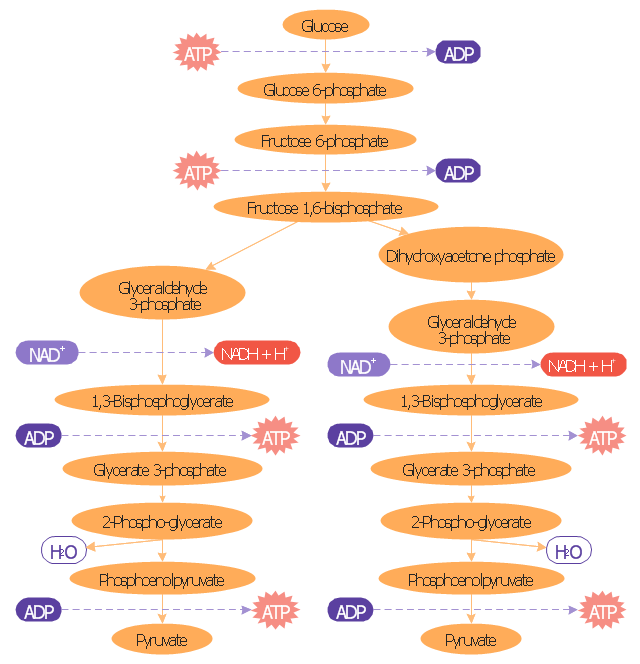
Image result for glycolysis pathway diagram
   
Cori Cycle 
•      Lactate is formed in the active muscle to regenerate NAD+ from NADH so that glycolysis can continue. 

•      The muscle cannot spare NAD+ for re-conversion of lactate back to pyruvate. 

•      Thus, lactate is transported to the liver, where, in the presence of oxygen, it undergoes gluconeogenesis to form glucose. 

•      The glucose is supplied by the liver to various tissues including muscle. 

•      This inter-organ cooperation during high muscular activity is called as the Cori cycle. 


Sunday, 24 February 2019

Gel Electrophoresis- Genetic Technology

Gel Electrophoresis

Gel electrophoresis is a technique used to separate DNA fragments (or other macromolecules, such as RNA and proteins) based on their size and charge.
The suffix phoresis means "migration" or "movement."  The prefix electro tells us that we are using electricity to make molecules migrate.
Electrophoresis involves running a current through a gel containing the molecules of interest. Based on their size and charge, the molecules will travel through the gel in different directions or at different speeds, allowing them to separate from one another.

Gel Electrophoresis of DNA
•      DNA is extracted from a sample, such as sperm, hair, etc.
•      DNA is chopped using enzymes called Restriction Endonucleases.
NB: Restriction endonucleases are enzymes that cut specific regions in the DNA sequence. They cut the sugar phosphate bone to give either sticky ends or blunt ends.
•      Restriction Endonucleases cleave the DNA close to VNTR region.
NB: Variable tandem number repeat is a repeat sequence in the DNA that is different in each person.
•      The DNA is ready for electrophoresis
NB: If you’re comparing DNA, cut both DNA with the same restriction enzyme.
•      Place the DNA fragments in a well with an electric current applied using a teat pipette. The DNA should be on the negative side or the cathode since it is negatively charged. Phosphates in nucleotides of DNA have negative charge. This gives the DNA a negative charge. 
•      All DNA molecules have the same amount of charge per mass. Because of this, gel electrophoresis of DNA fragments separates them based on size only.Since DNA is negatively charged, it will travel to the positive side. Smaller fragments travel furthest as they have smaller mass. Larger fragments are slower and would travel the least.
•      When a gel is stained with a DNA-binding dye and placed under UV light, the DNA fragments will glow, allowing us to see the DNA present at different locations along the length of the gel.
•      Probes can also be added to make the film go dark when placed on an X-Ray film
•      A well-defined “line” of DNA on a gel is called a band. Each band contains a large number of DNA fragments of the same size that have all travelled as a group to the same position
•      One well is reserved for a DNA ladder, a standard reference that contains DNA fragments of known lengths. By comparing the bands in a sample to the DNA ladder, we can determine their approximate sizes. Helps give estimates of how long the other base pairs are when run alongside it.

Gel electrophoresis has many uses ranging from criminal investigations to paternity tests. It is used in conjunction with other techniques to determine if someone has a particular allele of a gene, such as screening for sickle cell anaemia.  

.


Malaria Infectious Diseases


Malaria

Malaria is a deadly infectious disease caused by the protozoa Plasmodium. An infectious disease is caused by a pathogen and is referred to as communicable as it is transferred from an infected to uninfected person. Malaria has four pathogens: Plasmodium falciparum, P. vivax, P. ovale, P. malariae, which are all transferred by the by the vector (a vector is an organism which carries a disease from one person to another or from an animal to a human): the female Anopheles mosquito. Malaria affects 500 million and kills more than 1 million people each year. It is endemic in more than 100 third world countries in tropical and subtropical regions such as Sub-Saharan Africa, Asia and Latin America. It is maintained there by transmission between people.
NB: Endemic means native or confined to a certain place or constantly present to a greater or lesser extent in a particular locality.

Transmission of Malaria
There are three ways in which malaria can be transmitted:
1.    The female anopheles mosquito
2.    Blood transfusion and when unsterile needles are re-used
3.    Movement from the placenta into the fetus
When a mosquito bites a person, blood taken by mosquitoes provides protein and iron needed for formation of eggs. If the person is a carrier for malaria or is infected with Plasmodium, the mosquito takes some of the gametes from the blood meal. These male and female gametes fuse in the mosquito’s gut to form infective stages, which move to the mosquito’s salivary glands. When she feeds again, she injects an anticoagulant from her salivary glands that prevents the blood meal from clotting so blood can flow freely from the human to the mosquito. The infective stages pass from the mosquito’s salivary glands into the human’s blood flow including the anticoagulant and enter the red blood cells where they multiply.
NB: “anti”- against, opposite “coagulant” causes coagulation which is to thicken or to change from liquid to a solid state. Hence, they are chemical substances that prevent or reduce coagulation of blood
Plasmodium is carried in the bloodstream to the liver, where they invade liver cells and reproduce asexually. At about eight days after infection, the liver cells burst, releasing millions of Plasmodium into the bloodstream where they invade the red blood cells.

Plasmodium reproduces asexually inside the red blood cells. Within the red cells the parasites grow in a membrane-bound digestive vacuole, hydrolyzing haemoglobin through secreted enzymes. Some parasites develop into sexual forms called Gametocytes, which infect the mosquito. Plasmodium makes you ill about 10-15 days after infection, when they burst out of the red blood cells and release a chemical that causes fever. The Plasmodium is then free to invade more red blood cells. A person may have many bouts of malaria fever.
At each stage, there is a huge increase the number of parasites, increasing the chances of infecting another mosquito or human.

Symptoms of Malaria
Typically, victims who are bitten by malaria-carrying mosquitoes experience no symptoms until 10 to 28 days after infection. The first clinical signs may be any combination of chills, fever, headache, muscle ache, nausea, vomiting, diarrhea, and abdominal cramps. Chills and fever occur in periodic attacks; these last 4 to 10 hours and consist first of a stage of shaking and chills, then a stage of fever and severe headache, and finally a stage of profuse sweating during which the temperature drops back to normal. Persons with malaria commonly have anaemia (owing to the destruction of red blood cells by the parasites), enlargement of the spleen (the organ responsible for ridding the body of degenerate red blood cells), and general weakness and debility.


Treatment of Malaria
This is through the use of anti-malarial drugs including quinine and chloroquine. These can be used as prophylactic (preventative) drugs, stopping an infection from occurring if the person is bitten. This is taken before or after visiting an area where malaria is endemic. Chloroquine inhibits protein synthesis and prevents the parasite from spreading. Proguanil inhibits sexual reproduction of Plasmodium within the biting mosquito.
When these drugs are used widely, Plasmodium has become resistant.  An example is chloroquine in parts of South Africa, Africa and New Guinea, leading to the introduction of mefloquine, which is rather expensive and has some unpleasant side effects such as restlessness, dizziness, vomiting and disturbed sleep.

Prevention of Malaria
The way in which a pathogen passes from one host to another is called a transmission cycle. Control methods try to break this cycle by removing conditions that are favourable for the spread of the pathogen. Prevention and control methods include:
§  Stocking ponds, irrigation and drainage of ditches and other permanent bodies of water with fish with which feed on mosquito larvae.
§  Spraying a preparation containing bacteria that kills mosquito larvae.
§  Sleeping under mosquito nets to avoid being bitten by mosquitoes.
§  Spraying oil or paraffin on stagnant bodies of water.
§  Use of drugs to kill the parasite
§  Killing adult mosquitoes with insecticides such as DDT

Worldwide Concerns
Malaria prevention programs are unsuccessful as:
§  Plasmodium became resistant to drugs used to control it.
§   Mosquitoes become resistant to DDT and other insecticides.
The reason for worldwide concern over malaria stems from:
§  An increase in drug-resistant forms of Plasmodium
§  An increase in the proportion of cases caused by P. falciparum, the form that causes severe, often fatal malaria.
§  Difficulties in developing vaccines against malaria
§  An increase in the number of epidemics, caused by climatic and environmental changes that favour the spread of mosquitoes.
§  Migration of people from areas where malaria is endemic, for political and economic reasons
Control methods now focus on working within health systems to improve diagnosis, improve the supply of effective drugs and promote appropriate methods to prevent transmission. Plasmodium genome has been sequenced, which may lead to the development of effective vaccines. Drugs are used in combinations to reduce the chances of drug resistance arising.
Three factors may lead to improvements in the control of malaria:
§  Use of modern techniques in gene sequencing and drug design
§  Development of vaccines targeted against different stages of the parasites life cycle.
§  A renewed international will to remove the burden of disease from the poorest parts of the world, allied to generous donations from wealthy individuals and foundations.